Tuesday, July 30, 2024

Migrating to Substack

 Public Service Announcment


I've moved my writing to Substack and will no longer be posting content to Blogger. 


Here's a link to one of my Substack posts:


https://bitcoinbridge.substack.com/p/bitcoin-and-whole-life-are-homework


Hope you migrate over there and I welcome you to subscribe so you'll be notified when I create more content.


Cheers,


John Montoya

Saturday, February 25, 2023

How Much, In Dollars, Do You Love Yourself (and Your Family)?

On Valentine’s Day we typically express our love for our significant other with a gift.  The idea of gifting the person you love with a life insurance policy is a bit morbid though.  Nonetheless, it does certainly say something about how much you value your relationship more than any other gift you can give.  One of the great advantages of life insurance is that it allows you to create an estate of substantial size before you’ve actually saved to create it.

But what if you’re single?  What if there is no need for you to replace your income or have your mortgage paid in the event of an untimely death?  Is there no need for life insurance?

I’ll argue you despite not having a person depending on you to carry on with the life you’ve built together, there is still need for life insurance and specifically a Whole Life policy which I’ll simply refer to as a Cash Value policy.  In fact, I’ll give you two reasons.


#1: Tax-Free Source of Funds During Your Working Years

There’s only two realistic places to park cash where it is allowed to grow tax-free:  Roth IRA and Cash Value policy. 


Roth IRA’s are great for retirement but there are too many restrictions to limit its utility during your pre-retirement years.  Limits to annual contributions and if your income is too high, then you can’t contribute at all.  There’s also the issue of access to your account balance being restricted to only your contributions, and if you would like to restore the withdrawal, you have only 60 days to do so.  


Cash Value policies do not limit you with regards to annual contributions (called premium) or limit access to available cash values for any reason. Higher income earners are not excluded. However, not everyone can have a Cash Value Life Insurance policy.  The reason being you must qualify for life insurance.  If you are in poor or marginal health, it’s possible to get declined.  


Ideally, you have both types of vehicles at your disposal.  If you’re thinking a Roth IRA is more important, here are some things to consider.  


Don’t discount your need to have a safe place to have available source of money always growing regardless of market conditions.  People keep a traditional checking account to pay bills but also to maintain an emergency savings account.  A traditional bank is crucial and a necessity for bill paying but not for emergencies when a Cash Value policy provides so much more value:

- better long-term growth

- no 1099’s to report interest

- ability to take policy loans against cash value balance without interrupting growth

- ability to repay the loans with any amount and with any frequency of your choosing

- additional death benefit 

- moral reasons: fractional reserve banking contributes to inflation whereas full reserve life insurance companies do not.  Society decays when money decays.  There is something to be said about not contributing to the problem by leaving only the minimum on deposit at traditional banks to pay monthly bills (plus 2-3 months cushion).  


90 days is plenty of time move money from a cash value policy to a bank account when funds can be delivered via Electronic Fund Transfer (EFT) from life insurance companies in 3-5 days.


Your ability to be safe and liquid without an over reliance on a traditional bank during (and after) your working years is as much of a necessity as saving for retirement with a Roth IRA.  After all, you have need to finance your lifestyle for ALL YEARS of your life.  If you fail to capitalize properly in the best place, traditional banks are all too happy to extend you money via credit cards at 18-25+%.  This is a debt trap best avoided.


Remember Mark Twain said: “A banker is a fellow who lends you his umbrella when the sun is shining, but wants it back the minute it begins to rain.”


Cash Value policies allow you to be your own banker instead!  Learn more by listening to the podcast I co-host: The Fifth Edition.


#2: Tax-Free Source of Funds During Your Non-Working Years


I’ll wager you’ve never considered Cash Value Life Insurance for retirement purposes.  It’s not part of conventional thinking when we’re conditioned to save for retirement via government controlled (qualified) vehicles like 401k/403b/457 and IRA accounts.  And consider that these qualified retirement accounts offer only one option for income:  withdrawals without any hedge for outliving your account balance (no lifetime guarantee options).


Nonetheless, there are numerous additional benefits and advantages to having a Cash Value policy in your overall financial portfolio:

- non-correlated asset

- guaranteed cash value increases each year

- ability to customize withdrawals or take policy loans for tax-free income

- ability to annuitize cash value for guaranteed lifetime income

- availability to have access to the death benefit as an additional source of funds due to terminal or chronic illness

- ability to combine with other assets like 401k/IRA’s to create additional retirement income strategies that produce more income than 401k/IRA’s will provide on their own: 

  1. Covered Asset Strategy
  2. Volatility Buffer Strategy


Summary


Single people: Look past the death benefit as a reason to own permanent life insurance.  Cash Value Life Insurance is an incredible gift you can give yourself that carry benefits and advantages which are too important to overlook.  I give you 2 reasons own a cash value policy: tax-free use and control of your money during working and non-working years, in one place no less.


The best time to start is always yesterday.  Remember, your health is never guaranteed and this is the one financial account that must be medically qualified for.  

Though Valentine’s Day comes around once a year, this is a gift you can give yourself any day of the year.  My advice is to get started sooner rather than later.  Your future self will appreciate you had the foresight to think both long-term and unconventionally.


Here’s the best way to connect with me:  www.IBC.guru


Thank you,


John Montoya

Wednesday, February 1, 2023

There is No Secret Ingredient

One of my favorite movies is Kung Fu Panda and the lesson about the secret ingredient applies to Whole Life.


When people learn about Infinite Banking, they feel like they discovered something that wonderfully new and magical.  The truth is though there is nothing magical about Infinite Banking or Whole Life policies other than the perceived newness of it.


There’s a mystical feeling about making a discovery, traveling some place new, and the a-ha moment with Infinite Banking and Whole Life is like that, too.  But there is no magic about it, no sleight of hand.  This is a good thing because if there was something magical or some sort of con involved to distract your attention, Whole Life insurance would be, well, Universal Life insurance.


Same thing with Infinite Banking.  It’s perhaps a novel idea at first until you realize banking has been around for thousands of years.  People who have saved will lend to those who need capital and the cost to the borrower is interest.  


If you’ve ever loaned a friend or family member money, you’ve banked at the individual level.  It’s that simple.  At a larger level, that’s the role traditional banks have filled for people who haven’t saved enough capital for what they want or need.  But the banking function of lending is not exclusive to banks.  We are just conditioned to think it is.


Enter Infinite Banking at the individual level.  The “you and me” level as Nelson Nash used to say.  He would also tell people the banking function doesn’t have to be done with Whole Life.  It can be accomplished with a Bank Line of Credit (Home, business, or personal).  It can be done with a checking/savings account.  However, his conclusion was Whole Life was the best financial vehicle to harness the banking function. Infinite Banking was born and his book Becoming Your Own Banker was written to help people understand a different way of solving for our greatest financial need:  financing.


To be clear, Infinite Banking and Whole Life are two separate things.  The former is a strategy, the latter is a financial product.  IBC requires a financial product.  Whole Life doesn’t require Infinite Banking.  


What Whole Life accomplishes through its guarantees and predictability is make it the best choice to practice the banking function in your own life.  Rather than relying on traditional banks for all the major capital you’ll require in your life, you can instead Become Your Own Banker.  


And Whole Life works so well because there is no magic to it.  Or as say, “no luck, skill, or guesswork.”

Premiums paid result in guaranteed cash value.  Only in a Whole Life policy does the cash value represent the equity you own in the death benefit.  Consider a 30 year fixed mortgage as an analogy:  level payments for all years where each mortgage payment results in an increasing equity position for the home owner.  Same thing for Whole Life where each premium results in a growing equity position of the death benefit until the cash value ultimately must equal the death benefit. This never happens with Universal Life policies.


I’ll explain Universal Life this way:  you lease the death benefit, you never own it.  


The reason why is because the cost of insurance in Universal policies in designed to increase every year and any additional amount paid above the cost of insurance is unbundled into an interest bearing account which is the cash value in a Universal policy.  Since the cash value floats based on whatever interest crediting option available in the product in Universal policies, performance requires “luck, skill, and guesswork”. The cash values must also stay above the increasing cost of insurance or the policy will begin to eat itself.  There is nothing certain about Universal policies unlike a Whole Life policy.  


To sum up, there’s nothing magical about Infinite Banking and Whole Life.  No secret ingredient.  Whole Life is based on guaranteed numbers (math).  As a result, its performance is guaranteed by the life insurance companies that offer it.  Infinite Banking is the idea and strategy eliminating the middle man banking institutions.  


Monday, January 9, 2023

The Biggest Lie About Whole Life Insurance


Text from a potential client:  I was reading that for many whole life policies you don’t get the cash value upon death, is that true?


Thankfully, this is 100% NOT TRUE!  But it is true that this lie is perpetuated around the internet as gospel and people hear or read this so often that they believe it to be true.  


So here’s quick explanation to put this lie to rest and this will help you understand how a Whole Life policy works.


Lets first understand a Whole Life policy operates on a contractual guaranteed basis to accomplish what you want to have happen.  I’ll come back to this.


Second, let’s have a thought exercise to help in learning.


Imagine if you will that you have a retirement goal to accumulate $1,000,000.  How would you do it?


Option #1: Invest

At one end of the spectrum, the riskiest way is to invest because investments entail risk of loss.  While we all no doubt would like to accumulate $1,000,000 using the fewest dollars possible, investing offers no straight line to the end goal.  Look at any valuation chart of your favorite index.  Returns will zig zag and ride the market roller coaster.  There are no guarantees of arriving at $1,000,000.  Past performance be damned (if we’re being honest).

Option #2: Save

At the other end of the spectrum is the least volatile way to create a straight line to $1,000,000 and that is to simply save. To keep things simple, assume no yield on savings and no inflation.  Just save and you will get there but it will require the full $1,000,000 saved on your part in order to equal the $1,000,000 target end goal.  While this is the least efficient way to accumulate $1m, it is also the only “guaranteed” method.


How long it takes to reach $1 million is up to your capacity ($100 a month, $1000 a month, $10,000 a month, etc.) and your discipline level as the saver but with enough time, money, and discipline the $1,000,000 savings goal will be achieved.


There's one problem with both options though.  One unknown variable with both the investing and savings option is mortality which is why I wrote “guaranteed” a couple paragraphs above.  You might die prematurely before you ever reach $1,000,000.  There’s no guarantee you’ll live long enough to save (or invest) enough to equal $1,000,000.


This is where Whole Life insurance comes in.  In order to make certain what you want to have happen, will happen, you require insurance on your life as a hedge.  Only a Whole Life can guarantee you reach your investing/savings goal, even if you’re not alive to realize it.  (The main problem with Term and Universal is that you likely will outlive both because of the fatal design flaw built into those policies... increasing future premiums.)


Whole Life accomplishes an inevitable outcome at the most basic level.  Think of it as a guaranteed savings vehicle with a death benefit attached.  As you pay premiums (save money), you get closer to your end goal. If you pass away before reaching the end goal, the insurance company is on the hook for the difference between the cash value and the death benefit, called Net Amount At Risk.  This is the insurance part of the policy.


Only with a Whole Life policy are you contractually guaranteed the premiums will equal the death benefit at your time of death, or if you live long enough, at the end of the contract (up to age 121).  In layman's terms, if you save the money, you'll reach your goal no matter what.  


Each year as you age you get closer to the cash value equaling the death benefit.  This is called Endowment.  Only a Whole Life policy is guaranteed to endow (cash value equaling the death benefit).  


Here’s the major takeaway:


What people don’t realize about how Whole Life policies work is that the cash value is the present value of the future death benefit.  Read that again please.  Let it sink in.


For proof, look at the death benefit in the final year of any Whole Life illustration.  At the bottom on the left side is the Guaranteed Ledger. Each year the Total Cash Value is increasing and getting closer to the guaranteed Total Death Benefit.  Scroll down to age 121. You'll find the Cash Value now equals the Death Benefit.  This is contractually guaranteed with Whole Life and every Whole Life policy operates the same way or it's not a Whole Life policy.  I've lost count of how many people have a Universal policy thinking it's Whole life...  (The Non-Guaranteed Ledger below on the right includes Dividends.  Dividends are icing on the cake, if you will.)


When you understand that the Whole Life premiums you are paying are creating cash value and that the increasing cash values  represents the present value of the death benefit, you’ll realize the insurance company can’t keep the cash value because the cash value is 100% entwined and part of the death benefit payout.  Actuarial science and contract law makes this a mathematical certainty that the premium paid into the policy will accumulate internally to equal the death benefit.


What you’ve accomplished with your deliciously boring Whole Life policy is to guarantee that you will save your way to $1,000,000 via premiums (some call it “forced savings”) and if you aren’t alive to reach the goal, your beneficiary will be recipient of the $1,000,000 tax-free death benefit.  It’s boring because you know with certainty this will happen.  No luck, skill, or guess work required.  And I'll add a Whole Life policy has been an extremely peaceful and stress-free way to organize my life.


In a nutshell, it’s a guaranteed savings vehicle with a death benefit attached.


Now repeat after me:  


The life insurance company can’t keep your cash value because the cash value is part of the death benefit.

The life insurance company can’t keep your cash value because the cash value is part of the death benefit.

The life insurance company can’t keep your cash value because the cash value is part of the death benefit.

The life insurance company can’t keep your cash value because the cash value is part of the death benefit.

The life insurance company can’t keep your cash value because the cash value is part of the death benefit.

The life insurance company can’t keep your cash value because the cash value is part of the death benefit.

The life insurance company can’t keep your cash value because the cash value is part of the death benefit.

The life insurance company can’t keep your cash value because the cash value is part of the death benefit.

The life insurance company can’t keep your cash value because the cash value is part of the death benefit.


Cheers,


John Montoya


Tuesday, January 3, 2023

Term, Universal and Whole Life Insurance: Price is What You Pay, Value is What You Get

Here’s a simple explanation of life insurance in order of product history with some anecdotes sprinkled in from my life experience.


1. Term is the oldest.  No cash value.  Death benefit has a level cost (premium) for a “term” period.  After the term period (common example: 10, 20, or 30 years), the premium increases annually at an ever-increasing cost.  Hypothetically, one could pay the rising annual premiums to age 95 or 100 (per the contract) but effectively no one ever does because premiums become too outrageous.  Benefit is the temporary cheap death benefit.


2. Whole Life was introduced after Term around 150 years ago because customers wanted a permanent death benefit.  Whole life covers the “whole” or entirety of one’s life up to age 121, if you live that long.  There is cash value.  Premiums are guaranteed level for the life of the contract.  Overage of premium is returned to the policy holder as a dividend.  Cash values guaranteed to increase because cash values must eventually equal the death benefit on the last day of the contract in year 121.  This is called endowment.  Only a Whole Life policy can guarantee endowment.  Benefits (short list): level premiums for life, guaranteed cash values which can be accessed while living for any reason, guaranteed death benefit for life.


3. Universal was introduced about 40 years ago.  It separates the cost of insurance from the interest component so that the cost of insurance adjusts once a year for the life of the contract.  This is known as Annual Renewable Term. Universal policies has the illusion of being cheaper than Whole Life because the cost of insurance at time of policy issue is very inexpensive.  But as the insured ages, the cost of insurance increases annually to better price the mortality risk (closer to dying).  What was once very cheap becomes extremely expensive by late 60’s getting exponentially more expensive into 70s, 80’s and beyond if there is still enough cash value to support the rising costs internally without the policy owner having to come out of pocket to offset the cost of rising premium.  Benefit:  cheap at first, “permanent” death benefit.


Universal is “Permanent” much like how a term policy could be considered permanent.  Technically, if a person were willing to pay the increasing cost of premium every year to age 95 (or the end of the contract), both a term and universal policy would be permanent, indeed.  


The reality is altogether different.  Because only a Whole Life policy locks in a guaranteed level premium, it is the only life insurance contract that is in effect permanent.


Hucksters (Dave Ramsey) and life insurance salesman with limited training will recommend Universal making the common mistake of thinking it is cheaper than the Whole Life but the reality is, like term insurance, being cheap is temporary.  Eventually, the price of the insurance policy will catch up to its true cost.


Having worked at Nordstrom in my college years selling expensive but high quality men’s dress shoes I learned a valuable lesson:  Price is what you pay, value is what you get.


I learned it was easy to buy the $80 dress shoes that would hold up for maybe 6 months but it was smarter to spend $220 on shoes that would last 4-5 years or longer. 


I approach life insurance the same way.  Term insurance certainly has a place.  For my money, I want a guaranteed convertible term policy so I always have the option to covert to a Whole Life policy.  But when purchasing permanent life insurance, I want the best value I can get.  That only applies with Whole Life because I know the guarantees with Whole Life make sure the premiums are locked in.  I’m transferring the risk of ever being unable to afford the policy as I age and I have cash values that won’t be cannabalized by rising mortality costs like with Universal policies.


I think of Whole Life as similar to a 30 year fixed mortgage.  When I’m shopping for a home, I’m going to choose the financing option that will provide a level payment until the home is paid for.  It’s common sense if you’re going to live in the home for a longer time.  Sort of like shopping for a life insurance plan and planning to be alive for as long as possible… I’d never choose a 1 year adjustable mortgage when buying my home.  In mortgage terms, that’s essentially a Universal Life policy.


We all know what happened in the Great Financial Crisis from 2007-09.  The movie The Big Short chronicles it extremely well.  A few individuals saw the writing on the wall with all gimmicky artificially low interest rates that were set to adjust much higher after the initial term expired and they bet against the housing market making millions, even billions, in the process.


Why do you think life insurance companies love to sell term and Universal policies?  They know they are going to be let off the hook of paying a death benefit because people will either outlive the term policy and won’t be able to keep up with the rising cost of insurance.  Like a home going into foreclosure where the bank repossesses all equity and the house, the life insurance company will keep all the premium (term) paid or in the case of Universal, surrender what’s left of the cash value.  The death benefit is temporary is both cases.


Takeaway: a death benefit can only be guaranteed if the policy owner can afford to pay the premiums or there is enough cash value and/or built up death benefit to pay up the remaining policy premiums to achieve endowment.  Only Whole Life makes this possible because the premium is calculated and guaranteed by the underwriters to cover a level cost of insurance for the life of the policy.  


Price is what you pay.  Value is what you get.


Additional note:


Since Universal policies subject the interest credited to either money market like rates (Universal), or mutual fund like securities (Variable Universal), or even ETF like funds with caps and participation rates (Indexed Universal), there does exist for the possibility for the excess premium (cash values) above the rising cost of insurance premium to accumulate and stay ahead of future mortality expenses.  However, as noted, because the rising cost of insurance is never locked in beyond a year at a time with Universal policies, the risk of the policy performing as one hopes for when making the purchase always resides with the policy owner, never the life insurance company.  The insurance company bears no risk for non-performance because the interest component is unbundled from the cost of insurance.  The risk of the universal life policy performing, because cash values aren’t guaranteed to increase to eventually equal the death benefit like with Whole Life, is left to uncertainty.


 Thank you,


John Montoya


Connect With Me Here


Tuesday, November 22, 2022

Trust But Verify

Trust but verify.  This ethos is heard often in the Bitcoin world but the same adage could easily be assigned to Whole Life.


So many people dismiss Whole Life at first mention because of what they think they know.  Most people’s understanding of Whole Life, in my experience, is based on someone’s misunderstanding. 


But there’s a very easy way to determine if Whole Life is what portends to be from those who claim to really know it and those who dismiss it so easily.  Verify.


How?  


Easy.  Talk to an experienced and qualified expert in Whole Life. Connect with someone like myself who has 20+ years in the life insurance industry, co-hosts a podcast, licensed in 45+ states, and happens to walk their own talk.  


I can answer all the elusive questions.  I can also go a step further to show you how a Whole Life policy can be structured to guarantee a future outcome:  

Retirement income

Rainy day fund

Capital for investing in real estate and business ventures

College funding for the kids

Excess pool of money to cover a long-term care health event

Tax-free transfer of wealth


And all within a budget you can work with.  All verifiable.  No need to trust me or whoever might be in your ear leading you astray.  See for yourself.  As it’s said:  The proof is in the pudding.


You can reach me here:


CALENDAR:   Www.IBC.guru


Thank you,


John Montoya


Friday, November 4, 2022

The Two Ways To Thrive & Prosper in the Current Debt-Based Financial System

What will be the best way to thrive and prosper in a fiat (debt-based) monetary system?


Answer: Through the use of honest, sound money systems to preserve, grow, and transfer wealth.


Does this actually exist?


Yes, in two places:


Whole Life insurance policies and the Bitcoin protocol.


Whole Life exists within the current legacy financial system and is engineered on a full reserve basis. This is extremely important.  Life insurance companies by law cannot print or create money (credit or IOU’s).  Unlike the banking system that can loan beyond what they hold in reserves, the life insurance industry is restricted from doing so.  As a result, life insurance companies are financially solvent which is a requirement enforced by the legal system.


This is important because what happens when the music (free money printer) stops?  The world enters a liquidity crisis because the credit system must eventually unwind at the end of each “business cycle”. Banks stop lending, asset prices drop, companies start laying off, people are worse off… except for those people who value honest, sound money systems and warehouse a portion of their assets with mutual based life insurance companies via Whole Life policies. 


With a Whole Life policy, there is no liquidity crisis for the policy owner.  Policy owners have access to their cash value at any time for any reason, either as withdrawal or using the cash value as collateral for a guaranteed loan.  Life insurance companies must make the cash value available to the policyholder because policyholders have the first priority to the money within the life company.  Compare to a bank where a depositor is a creditor to the bank and do not have first priority.  


There is a long history of bank runs and credit bubbles bursting.  People unfortunately learn the hard way and/or lessons are quickly forgotten or never learned in the first place.  The history of money is not taught in schools and the majority of adults won't ever read another book after graduating high school.  Throw in what think they know about life insurance which isn't so, and well, Infinite Banking through Whole Life policies is beyond the comprehension of many.  


Be that as it may, Whole Life policies bridge the present monetary system with guarantees of future performance based on actuarial math.  Imagine if you will that Whole Life creates both present and future values; two time lines working together to guarantee a financial result based on the value of your life.  No other financial product does with a Whole Life does with safety, liquidity, and guarantees.


I've found only one drawback to Whole Life that it does not address on its own because Whole Life policies exist within the current legacy financial system that is likely on it's last legs.  I don't believe the dollar is going away anytime soon.


Consider the former reserve currency of the world: the pound sterling.  Called so because the currency in England literally was a pound of silver sterling.  It still exists today but like the dollar, it's no longer redeemable for silver.  Like all political money today, it is debt-based fiat created from nothing.  


The demise of the dollar is inevitable.  Study the history of money.  The question is how much longer will the United States government maintain its "exorbitant privilege"?  It could be 10, 20, 30 more years.  No one actually knows but you should be planning for a move back to sound money.


Gold existed as sound money for over 5000 years before bankers replaced gold holdings with IOU's.  We are likely to go back to a monetary system that is backed by a commodity like a gold but gold has proven to be corruptible by the banking elites.  This is because at the international level, huge amounts of gold is too expensive to protect, audit, and move.  


Enter Bitcoin.  The world’s first and only working answer to a trustless monetary system with no rulers. As Jeff Booth eloquently points out in his book The Price of Tomorrow and I’m going to paraphrase: the solution to a broken system cannot be created within the same broken system.  The solution must be created outside of the existing system.


Bitcoin exists outside of the current legacy financial system.  Bitcoin solves the problem created by debt-based money but in a different way than Whole Life.  While Whole Life policies create a system of money with guaranteed access and guaranteed results in the form of a unilateral contract backed by the full reserves of the life insurance company, the value of our IBC banking systems via Whole Life is denominated in fiat dollars which means the value of those dollars is trusted to the decisions of the Federal Reserve and its board of governors.  Though dollar denominated Whole Life policies can and have kept pace with a 2-4% inflation per year through the use of the Paid Up Addition’s rider and dividends reinvested back into the policy, there is the issue of store of value of maintaining generational value when the fiat monetary system erodes faster than 2-4% for a sustained period of time which is why I believe Bitcoin should supplement Whole Life cash values to further insulate against the continued planned debasement of the dollar.  


Historically all fiat currency values go to zero.  Bitcoin changes this because it introduces a rules based system with no rulers (no central bank, politicians, or CEO's) and Bitcoin has a finite supply that is always verifiable.  The value of all bitcoins cannot be devalued through dilution.  21 million is all there will ever be.  How many fiat dollars were created last year?  How many fiat dollars will be created next year? 5 years from now, 20 years from now and so on?  Nobody knows.


We can answer these questions with Bitcoin.  Bitcoin accomplishes the goal of sound money because the value of how much you own will be the same today as it will be at any point in the future.  A dollar from 1971 is not worth the same dollar in 2022.  One bitcoin will be one bitcoin 2052 or even 2152.  


Bitcoin offers a solution to credit based money that completely eliminates the government’s power to issue and therefore debase money over time.  Americans have the hardest time understanding this because we live in a world where the Dollar is currently king but citizens of other countries like Argentina, Venezuela, Nigeria, and Lebanon (to name just a few) know firsthand the debauchery of government issued money because they experience higher inflation rates (rapid debasement) with more regularity than we do in America.  It’s no wonder the adoption rate of Bitcoin is faster in those countries because it offers them a life raft to preserve their wealth.


Bitcoin is digital gold but so much more.  In world where we are conditioned to accept the prices must inflate in order for the system to work, we now have a technological breakthough that will be as important as the printing press was to breaking the monopoly the Catholic Church had over society 500 years ago.  Bitcoin is freedom mone and it has the power to break the government monopoly on money that exists today which has financed endless hot wars, cold wars, to the "wars" on poverty, drugs, terror, and coming soon... the war on information and free speech.  


To thrive and prosper as a sovereign individual, I invite to go down the rabbit hole with me on Whole Life and Bitcoin.  Follow me on Twitter here.  


Be mentally prepared that you will have to put in the work to eduate yourself about money.  There is a serious learning curve so those who cannot make the time to study and those who are unwilling to learn will see the value of their labor devalued by the current fiat monetary system purposely designed to steal their time (in the form of fiat money) and will be unable to do anything about it.


The terms "red pill" and "blue pill" refer to a choice between the willingness to learn a potentially unsettling or life-changing truth by taking the red pill or remaining in contented ignorance with the blue pill.


In The Matrix, the main character Neo is offered the choice between a red pill and a blue pill by rebel leader Morpheus. Morpheus says "You take the blue pill... the story ends, you wake up in your bed and believe whatever you want to believe. You take the red pill... you stay in Wonderland, and I show you how deep the rabbit hole goes." The red pill represents an uncertain future and, unknown to Neo at the time he takes it, the pill frees him from the enslaving control of the machine-generated dream world. The pill allows Neo to escape into the real world, where he lives in a pod and is being used as a battery - and finds that living the "truth of reality" is harsher and more difficult than living in the ignorance which the blue pill offers: continuing his life within the confined comfort, without want or fear, of the Matrix's simulated reality.


Neo chooses the red pill and joins the rebellion.


The choice is now yours.


To connect and get your questions answered, I invite you to book time with me here:  www.IBC.guru


Thank you,


John Montoya


Friday, March 4, 2022

Different Ideas On How To Use IBC (Including Retirement Income Options)


(From the IBC Mailbag - below is an email exchange from an existing client with policies on every member of the family.  I've consolidated my answers into a more readable format.)


Hi John, we have reached the seventh year of funding our original policies.  Now I would like to explore the various ways to use the policies as we go forward.  I have been re-reading R. Nelson Nash's book "Becoming Your Own Banker".  Many of his examples feature much longer time frames than we are currently at, and we have no current cash needs.  


The main options I see are:


Use dividends to pay premiums (although I have said we do not want to do this, I want to understand the math)


This is called an offset of premium.  First the dividends would be used to offset the premium.  If dividends do not completely cover the premium, then you could cover the difference or the death benefit could also be reduced to cover the shortfall.


Borrow cash for expenses we would normally finance, such as cars etc.


My rule of thumb:  Always shop for the money first.  If you can obtain lower financing and the monthly payments fit in your cashflow, choose the lower traditional financing and keep cash value in the policy available for investment purposes.  Always shop for the money first.  


Borrow cash for investment purposes, like the equipment leasing example.


This is the best use for cash values (assuming a person doesn’t have any high interest debt).  IBC Whole Life policies are what I call money multipliers because they allow the safest form leverage a person can get anywhere.  Policy owners can’t be turned down for a loan or have their cash reserves frozen, repayments are unscheduled.  Safe leverage allows for money to work in two places instead of one hence money multiplier.


Borrow cash to pay off our mortgage.


This is my least favorite option because mortgages at today’s rates are ridiculously cheap and locked for up to 30 years.  The dollar is purposely designed to devalue over time so if there is one benefit to inflation, this is it.  That said, everybody’s situation is different and if paying off the remainder of mortgage frees up additional cash flow to use in retirement, then that makes sense.  I’m just in favorite of it if the mortgage is relatively newer and there is strong cash flow and a very healthy balance sheet of assets.


Common Income Options With Whole Life.


  • Withdraw dividends for income:  Nelson used to tell the story of how withdrew dividends from his first whole life policy while he was working and then later regretted it.  This is because those dividends when re-invested helped compound both the cash value and the death benefit.  In retirement, however, different story. Withdrawing dividends IS an option to consider to supplement income.

  • Another option is to withdraw cash values up to your contribution basis in the policy (non-taxable), and then take loans (also non-taxable) to continue supplementing income in retirement.


Other Income Options (especially if you have 401k/IRA retirement accounts)


  • Leverage the death benefit of a whole life policy to buy an income producing annuity from a 401k/IRA account.  401k/IRA’s are supposed to provide income via withdrawals in retirement but the problem is risk and longevity.  Pull out too much too soon and/or the market has a major correction, there will be little left to withdraw in later years.  The right type of annuities can provide up to a 50% increase in income over a 3-4% 401k/IRA withdrawal strategy and the annuity income is also guaranteed for life.  The permanent death benefit of the Whole Life policy provides the replacement of any funds put into the annuity from the 401k/IRA.

  • Volatility Buffer Strategy:  Don’t buy the annuity, keep money in the 401k/IRA invested in the market.  When the market loses money, do not withdraw from 401k/IRA retirement accounts.  Instead withdraw/policy loan from Whole Life policy.  This allows the market based money to recover from the prior year losses without depleting the accounts further during a down year.  In this strategy, 401k/IRA (market based assets) will last longer.


Use cash value to backstop self-insuring for collision & comprehensive coverage on our vehicles.


I’ve been doing this for a long time.  I only pay for liability insurance because I have the cash values to replace my car if it was totaled.  The excess savings increases my cash flow and that positive cash flow feeds more premium.


If you have an interest in learning how Infinite Banking could benefit you and your family, please reach out to me here:  www.IBC.guru


Thank you,


John Montoya


Monday, January 31, 2022

The Easiest Way Own Bitcoin Without Having To Buy Bitcoin


I've been including some information in my monthly newsletter in recent months about Bitcoin to help introduce this new burgeoning asset class to wider audience.  This month I'd like to go a step further to help those who maybe still aren't ready to exchange some of their fiat dollars to own Bitcoin for the first time.   Or if you already own Bitcoin, perhaps this will be an introduction on how to stack additional "sats" (fractions of bitcoin called satososhi's) without even thinking about it and with no money out of pocket.


First, it's important to understand what is Bitcoin so I'm including this fantastic Audio Glossary on Bitcoin by Natalie Brunell.  It's only 8 minutes and she covers a lot of ground in a short amount of time.


Next I'd like to help you develop your WHY for owning even a small amount makes absolute sense.  I'll do that by sharing my why.


I bought my first bitcoin for $356 in 2016 and though I've purchased more since initially I bought it because I loved the idea of an alternative peer to peer financial system that could operate outside of government influence (manipulation/corruption) and without 3rd party (banks and Wall Street) permission.  Does this sound familiar to Infinite Bankers and Austrian economists?


And it offered one additional, very unique characteristic compared to fiat money (government controlled dollars):  a fixed and predetermined supply of 21 million Bitcoins ever.  Finally, an honest and sound money system with no counterparty risk that actually works regardless of how you or I or any government feels about it.  Anyone with access to the internet can own a piece of this pristine digital asset.


Compare this to centrally controlled fiat currencies which requires the creation of debt to issue new units of fiat.  More buying units equals less purchasing power.  Think of this next time you go to the grocery store and try to recall, depending on your age, what a gallon of milk cost last year versus 20 or even 40 years ago.  


This is the government stealing your labor through inflation and it is centrally planned to work this way.  No conspiracy there except that "the powers that be" would you really prefer you not understand their capability to manipulate the money for as long as conceivably possible.
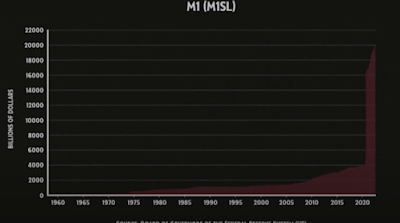

Since January 2020 the US has printed nearly 80% of all US dollars in existence. $4.0192 Trillion at the start of 2020, October 2021 $20.0831 Trillion


The existing monetary system is the root cause for a century of endless wars, expanding government, and neverending political disfunction.  Until Bitcoin, there was no free market alternative that could provide a solution to preserve the value of our labor.


Think about what money is?  It's a medium of exchange.  We exchange our time and energy (work/labor) for money.  But a lifetime of savings can be wiped out with a push of button because we are forced through Legal Tender laws to use politically controlled money that is purposely debased for the benefit of the entities in control of the money (government and banks).  


This debasement forfeits our labor ie savings gradually over time.  In a lot of countries around the world though, it's gradually and then suddenly.   Think Zimbabwe, Venezuela, Cuba, Turkey... Argentina, Mexico, Germany in the 1920's.


If you think a default on money can't and won't happen in the United States, here is your wake up call.  It happen in August of 1971.  That's when President Nixon "temporarily" closed the international exchange window for countries to redeem dollars for gold.  Simply put, there was an international run on the dollar because countries realized the United States government had more liabilities (created by the Vietnam war/new social welfare benefit programs) than gold to back to the supply of newly created money so they called in their gold reserves the US government had been safeguarding since World War 2.  The "Nixon Shock", still in effect to this day, was effectively a dollar default and it made all curriencies pegged to the  dollar with the dollar effectively pegged to the "faith and credit" of the United States government.  For 50+ years we've been operating in this fiat world and generations of us have never experienced anything else.  It's truly remarkable we've made it this far but there is a reckoning and we are now seeing it with highest inflations numbers in 4 decades.


For example, government manipulated Consumer Price Index reported recently 7% inflation year over year.  To rephrase this, the government stole 7% of the value of dollar demoninated assets you own.  And the inflation number was probably twice that.  


How does any of this make you feel?  Any type of theft should absolutely upset all of us but first we have to be aware of how it happens, who's behind it, and ultimately there has to be a working solution.


As an Infinite Banking policy holder (12 policies and counting) and licensed practitioner, the idealism behind Bitcoin immediately resonated back in 2016.  Bitcoin IS freedom and like Infinite Banking, it provides me the ability to take ownership, responsibility, and accountability for my financial life.   


So I bought Bitcoin initially on idealism.  And I set up monthly drafts of $50 and then $100 month to see what would happen and I more or less forgot about it for a couple of years.   I'll admit I didn't fully understand how Bitcoin worked.  I mean, how exactly is the network secured?  How does Proof of Work technology compare to Proof of Stake?  Why can't governments ban it or shut it down?


Though my faith has been rewarded in terms of long-term value since 2016, it wasn't until 2021 that I finally started reading about the technology behind Bitcoin with books like The Bullish Case For Bitcoin and December's newsletter book recommendation The Fiat Standard that I really found my conviction for Bitcoin.  Amazing what a bit of actual research will do.


Now I know in talking to many of you, there is concern about the price volatility of Bitcoin or regret that you didn't buy it a few years back.  Here's what I say to those people.  You have to stop thinking of Bitcoin like an investment.  This is very similar to how people confuse Infinite Banking Whole Life policies as an investment.  Neither are truly investments.  Reminder, IBC Whole Life is based on a contract and without extrapolating here, it is like a Swiss Army Knife in all benefits and functionality it provides.  


Bitcoin is a technology.  Bitcoin is a protocol.  Bitcoin is anti-Fiat.  Bitcoin is a life raft.  


After digging deeper into my research, this is my belief.  I believe Bitcoin ranks up there as one of the most important inventions in history alongside the printing press, the internet, and electricity.  


At the most basic level, I think it's vital to understand Bitcoin as a unit of account.  21 million Bitcoins finite.  That's it.  Never any more than 21 million and each Bitcoin can be divided into fractions as mentioned above.  This is important for Bitcoin to operate as a form of money.  Bitcoin is more than money, but if people are going to adopt it as money, it first needs be measurable as a unit of account.  


In comparison, how many US dollars is there in circulation?  Nobody truly knows but with Bitcoin you absolutely do know.  It is 100% transparent at all times and 100% verifiable.  Can't say that about any government controlled fiat currency.


Now let's tackle store of value.  If we know there will only be 21 million Bitcoin, we know if we began to hold Bitcoin instead of fiat currency, over the long term horizon Bitcoin will maintain its value better than an infinite supply of fiat currencies.  This preserves our labor instead of being forced to spend our money (or take on risky investments) to stay ahead of the devaluation of our dollar denominated fiat.  


Bitcoin is able to maintain a store of value because it has the most transparent ledger ever created.  Its transparency is also what makes it impossible to shut down, ban, or manipulate.  Unlike fiat, Bitcoin is immutable.  No government or large entity can change it.  There's a Bitcoin saying which is one of my favorites:  "You can't change Bitcoin.  Bitcoin changes you."


This might be difficult to understand right now, but keep this in mind.  Bitcoin is simultaneously everywhere and nowhere at the same time.  All the time.  This is because Bitcoin is a ledger of account that tracks every single Bitcoin in existence through its code which every node and miner that operates the bitcoin software possesses.  Nodes/Miners work together to confirm the existence of bitcoin and every transaction is then added to a blockchain ledger in a process that happens on average every 10 minutes forever.  


You can travel anywhere in the world and take your Bitcoin with you.  It truly is a remarkable feat.


I say this after being reminded during my trip to Costa Rica when I was asked upon leaving and returning if I had more than $10,000 cash or property in my possession.  Of course not.  I'm not going to carry on me that match cash to declare in order for it to be seized, but what about my Bitcoin?  I find it fascinating that Bitcoin is simultaneously everywhere and nowhere at the same time.  All the time.  It exists on a public blockchain so it goes where I go but only I have the private keys (cryptographic permission) to unlock control of the Bitcoin I own regardless of where I am in the world.  


Because the network is so effectively decentralized (no center point of failure to shut down) it remains the most secure network that has ever existed.  No other network competes with Bitcoin on security, reliability, and predictability.


Think about this from a government perspective who might choose to be hostile (China has tried to ban it maybe 17 times now?) towards Bitcoin rather than embrace it (El Salvador).  There is no Bitcoin company, no CEO, no board of directors, no on/off kill switch that any government can flip.  That's why Bitcoin exists everywhere and nowhere at the same time.  It is quite literally the internet of money.


Think of why the internet was created.  It was created as a messaging system in the event of a nuclear holocaust.  We no longer think of the internet in terms of the TCP/IP protocol which is the agreed upon language of the internet but the purpose of the internet is to communicate effectively and efficiently through the worst man-created nightmare we could imagine.  The internet cannot be shutdown.  The same with Bitcoin because it operates on the rails provided by the TCP/IP protocol which connects to nearly everything these days.  


So Bitcoin is a technology that secures allows each individual with access to the internet to send and receive messages through the internet with the use of electricity.  What type of technology?  It is software that provides a base level messaging protocol via a peer to peer network (through the use of nodes and mining equipment using a copy of the Bitcoin software) to communicate a message ("is this Bitcoin transaction good or bad?") from one end of the earth to the other at the speed of light.  The value of the message is inconsequential.  In fact for the first couple of years of its existance Bitcoin had no value until 10,000 Bitcoins were famously used to buy 2 pizzas giving a single Bitcoin its first price in fiat terms.   


What makes the Bitcoin network secure?  The very short answer:  Proof of Work.  Please read the recommended books for a detailed answer but I'll add this.: The current government fiat monetary system is based on something like Proof of Stake technology.  How well does this Proof of Stake technology work for you and I?  Social inequality grows unabated.  Ironically, so does the federal government.


The Keysian solution is always to "print" more money... and I think we're all starting to understand what's really happening.


Check the annual inflation figures and think about how the federal government has expanded beyond anything the Founding Fathers of this country ever intended or possibly could of imagined.  Money is truly the most powerful weapon against freedom that exists but it can also be the solution.


This is why the Bitcoin Adoption Rate exceeds even the adoption rate of the internet.  Think about that for a moment.  As great and transforming as the internet has been in so many countless ways in our life, more people around the world have adopted Bitcoin at a faster pace than use of the internet!


Why?  We are spoiled here in the United States because we currently hold status as the world's reserve currency.  Every other currency is pegged to our dollar but for how much longer?  As Voltaire said: Paper money eventually returns to its intrinsic value - zero.


In other counties where weaker fiat currencies exist, the adoption of Bitcoin is the highest.  This makes sense.  Bitcoin is a life raft for these people who are experiencing debilitating inflation that make the value of their money worthless at rate Americans can't possibly fathom.  We are truly blessed here in comparison but we have to realize that for us, it's just a slower bloodletting.  


As we learned from Nelson Nash and Infinite Banking, to be successful long-term we must think long-term.  And long-term should be your horizon for holding Bitcoin.  Anything less than 10 years and I would argue you are thinking in terms of price speculation and miscalculating the true value of Bitcoin.  It is a life raft.  It is the insurance against the evitable failure of government created fiat.  


Some of you may be thinking:  If Bitcoin is such an amazing technological invention that preserves the value of our capital long-term, then how does Infinite Banking still make sense?  Great question and I'll be answering it next month.


For now though, if you don't own any Bitcoin, I would like you to "get off of zero".  Here's the easiest way you can start "stacking sats" with no money out of pocket.  


GET OFF ZERO!


If you are like most people, you have a credit card and that credit likely has a rewards program that gives you points that you can redeem towards something.  That's all good and dandy but here's my truth now.  I don't want reward points I can redeem on Amazon or travel points I can redeem on Southwest Airlines or points I can redeem to offset the price of my Costco membership.


I want reward points that automatically pay me in Bitcoin that will be worth more to me and my family in future years as all fiat currencies continue to debase like they are created to do.


Since September I've made the Blockfi credit card my primary credit card earning bitcoin every single month since.  It is one of the easiest ways to "stack sats" I have found because all I have to do is remember to pay with BlockFi credit card.


If you use this link to register for your own BlockFi credit card, the current offer is we'll both receive $40 of Bitcoin.  Pretty nice!


No annual fees and no international charges when you travel abroad.  I used it everywhere I went in Costa Rica.


Also, be sure to register your card with Visa to be notified each time your credit card is used.  I do this with all my credit cards for security purposes.  I like to get text messages to my phone/Apple Watch each time there's a transaction.  The BlockFi card doesn't have this feature directly but it can be set up thru Visa using this link:  https://purchasealerts.visa.com/vca-web/login


Thank you for reading this far.  I hope you are now willing to take the Bitcoin plunge with me.  If you have questions for me regarding Bitcoin, please don't hesitate to reach out to me here:  www.IBC.guru  


Dollar cost averaging into Bitcoin is a topic I'll be covering in the near future and I'll be sharing the platform I use.  If you want the answer sooner, just reach out.  And yes, I'll be covering how to use IBC and Bitcoin together so stay tuned.


Thank you,


John Montoya