
There have been questions about what the impact will be for life
insurance companies and the Whole Life policy owners because of everything currently transpiring with the Coronavirus outbreak and the response by governments and central banks around the world.
Here’s one question that was recently asked: “How do Whole
Life policies perform relative to rising and falling interest rates?”
Whole Life policies work in both rising and falling interest rate enviroments because the growth is based on two components. First is the guaranteed interest. Whole Life policy owners receive this interest growth no matter what. It's baked into the cake so to speak.
The other part of the growth in Whole Life policies are the dividends which fluctuate with the interest rate environment. If interest rates are high, life insurance companies are earning a high yield and can pay higher dividends. When interest rates are as historically low as they have been for the past 12 years, then life insurance companies have smaller yields with which to pay dividends.
The great news is that Whole Life policies have performed well
over its 170+ year history. (And they actually
perform even better when designed for high early cash values utilizing the Paid-Up
Addition’s rider via the Infinite Banking strategy which I'll discuss at the end.)
Here’s why the history of whole life policies have stood the test of time.
Insurance companies need to invest all the premiums they collect
and their investment performance plays a large role in determining the surplus
profit used to pay dividends to policy holders.
Something important to note is that life insurance can’t
invest the way Wall Street firm invest because life insurance companies are in
business of providing guarantees. For whole life policies, there's the annual guaranteed interest to policy holders and ultimately a
death benefit guaranteed to beneficiaries. These guarantees mean life insurance companies have to be really conservative to ensure they have the assets to back up their
promises.
For this reason as much as 90% of a life insurance companies
portfolio is invested in corporate bonds and these debt instruments are typically
held to maturity because insurance companies love cash flow. And they love predictable cash flow even more. It’s
not as sexy as chasing double digit rates of return like the typical Wall Street trader but the strategy produces predictablely consistent returns. More importantly, it has proven work for life insurance companies which is what we want.
Hiccups like what we’re experiencing right now in the stock
market don’t have a short-term impact on life insurance companies and policy
holders for this reason.
The interest rate environment whether rising or falling will
influence future dividends but the shifts are extremely slow to manifest with life insurance
companies. Furthermore, interest rates are all relative. If interest
rates are low for life insurance companies, they are low for banks, too.
For example, when interest rates were at rising in the late
1970’s/early 1980’s, dividends payouts followed gradually. Whole Life policies actually had dividend
rates higher than 10% in the 1980’s. But
as interest rates have been steadily falling for the last couple of decades, so
have dividend scales.
Below are two charts showing the Prime Rate and the Federal
Funds Rate. The main take away in
looking at these two charts are to see that both interest rates are in sync. (Remember -interest rates are relative...when the cost for borrowing is high, so is the interest rate for saving)


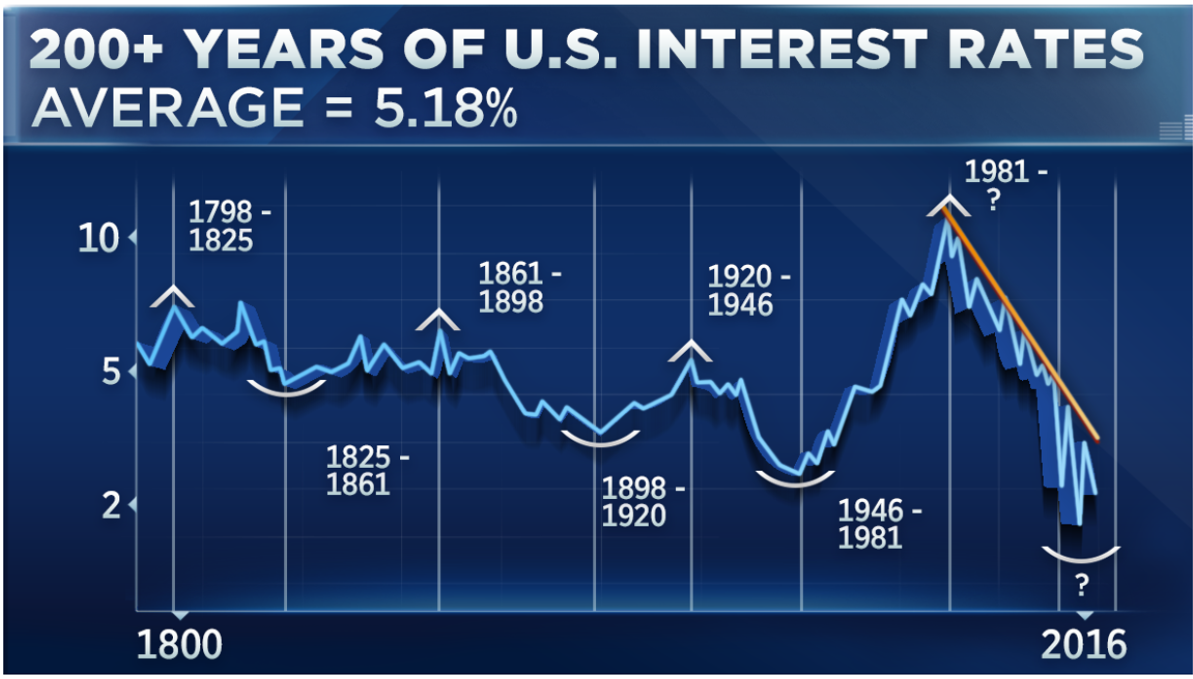
Now let’s look at a chart covering 200 years courtesy of
CNBC. The big takeaway over 200 year is
that interest rates have averaged 5.18%. This is about the same tax-free return currently yielding on IBC designed Whole Life policies.
Now let’s look at the Moody’s Corporate Bond Yield history
which aligns with historical rates on the previous with the previous charts. Remember that life insurance companies invest up 90% of their portfolio in AAA rated corporate bonds so their dividend scales will reflect the greater corporate bond market. (I've included the links to take to each chart if they are too small to see.)

You can see bond yields falling since the 1980’s. Yet despite falling interest rates over
multiple decades, Whole Life policies have steadily performed paying the
guaranteed interest and then dividends on top for additional growth.
From an illustration standpoint right now is actually the best
time to buy a Whole Life policy from a historical standpoint because if you look
at the policy guarantees as well as the non-guaranteed ledger (the non-guaranteed ledger includes future dividend assumptions based on the current scale),
the policies are illustrated to perform very well despite interest rates being
as historically low as they’ve ever been.
Of course, the flipside is that if you bought a Whole Life
policy in the 1980’s when dividends were at their highest, you’d be disappointed because you would have experienced a declining dividend scale
since then. However, you'd still have a whole life policy that is growing each year and earning dividends to help outpace inflation.
Eventually though interest rates will normalize. When that happens whole life policies purchased
in the past 10 years will outperform their current illustrations printed at issue. We just don’t know when interest rates will
rise. The Federal Reserve has basically
made it impossible for interest rates to achieve real market rates and this
market manipulation leads to another concern.
What happens if the Federal Reserve creates too much money
out of thin air and accelerates the devaluation of the dollar beyond the Fed’s
stated 2% annual inflation goal?
First, here’s some peace of mind. Just like how whole life policy values have endured regardless of the prevailing interest rate environment, these policies have also survived every
monetary change in the United States for the past 170+ years. It’s worth noting that
monetary systems change in some way about every 30 to 40 years.
Most people don’t realize it when buying a whole life policy but
the insurance companies they are buying a policy from have actually been in
business long before the the Federal Reserve was created. The Federal Reserve in its current form (INTERESTING FACT-it's
actually the 3rd central bank of the United States since the Declaration of
Independence in 1776) has only been around since 1913. I highly recommend reading The Creature From Jekyll Island if you want the full history on bankers and politicians plotted to create a central bank at a time when banks were despised by the general public. It's call the Federal Reserve for a good reason even though it's actually a private bank...
During the past 107 years the value of the dollar has shrunk by
94% since the Fed was created. Whole Life policies have managed to
perform through everything so far.
Coincidentally (or not), 1913 is the same year the IRS was created. It is a bit convenient that politicians would give banks the legal ability create money out of thin air which in turn enables politicians the ability to call on the Fed to borrow money secured by a constant source of revenue (income taxes)... if you stop to think about it...
Coincidentally (or not), 1913 is the same year the IRS was created. It is a bit convenient that politicians would give banks the legal ability create money out of thin air which in turn enables politicians the ability to call on the Fed to borrow money secured by a constant source of revenue (income taxes)... if you stop to think about it...
Here’s some of the monetary changes of the past change century
and whole life policies have survived them all.
FDR confiscated gold and made it illegal in the 1930's, then we had Bretton Woods system in 1944 making the dollar the top global currency (governments could exchange dollars for gold) until Nixon officially made the US dollar fiat over night in August 1972 essentially bringing us to our current system which is fiat the world over.
The big question though is how would hyperinflation affect Whole Life policies? That’s something Americans haven’t experienced but like the black swan event we are experiencing with the Coronavirus, anything is possible.
FDR confiscated gold and made it illegal in the 1930's, then we had Bretton Woods system in 1944 making the dollar the top global currency (governments could exchange dollars for gold) until Nixon officially made the US dollar fiat over night in August 1972 essentially bringing us to our current system which is fiat the world over.
The big question though is how would hyperinflation affect Whole Life policies? That’s something Americans haven’t experienced but like the black swan event we are experiencing with the Coronavirus, anything is possible.
The first thing to know about hyperinflation is that it doesn’t
happen overnight. The most referenced examples of hyperinflation in the past century happened in Germany in the early
1920s, Zimbabwe in the late 2000’s, and this past decade in Venezuela. In all cases, the devaluation happens
gradually at first and then accelerates to the point where inflation reaches
double digits on a monthly basis and then violently where inflation is 100%and
beyond on a weekly basis. We will be
painfully aware of accelerating devaluation when it arrives.
This is the plan with your Whole Life policies if hyperinflation happens to the US dollar:
- Take the maximum loan allowed to buy assets you feel would maintain value (gold, gold stocks, real estate, etc) then repay those loans with pennies on the dollar after the system resets, or
- Surrender the contract (whole life policies have no surrender penalties), use the cash value to buy assets you feel would maintain value (gold, gold stocks, real estate, etc. Assuming you are still in good health and can qualify, re-purchase your whole life policies once the new monetary system is settled.
Pretty straightforward.
No need to panic when you know you can choose option A or B. And that's if it ever happens here.
Moving beyond hyperinflation, we are experiencing inflation
but nothing alarming. I’d call our
current inflation experience “the gradual phase” and historically the gradual
phase is all we will ever experience because new monetary systems are introduced
30 to 40 years so that we never see the end result of the inflation game- that is people losing everything overnight.
Think of the Euro which came into existence in the late 1990’s. Every country in western Europe had their own
currency and then suddenly they didn’t.
But they didn’t lose all value over night. Currencies were revalued to a central
peg. It’s no different than other times
in history.
What’s next for the dollar?
Will it remain the top global currency?
I’m guessing it won’t. The Roman
Empire slowly crumbled over centuries until the barbarians destroyed it once and
for all. Nothing lasts forever. Not even a Whole Life policy… joking here but
Whole Life policies do endow at age 121 so they aren't engineered in perpetuity.
My prediction is that the dollar will be revalued by a
global bank and made part of basket of currencies. I can’t
predict when and I think it’s a fruitless exercise anyway.
Remember, the dollar was originally pegged to gold. It was actually a receipt for gold held in the
bank, hence bank note and a note is an IOU.
Think about the mortgage note you signed to buy or refinance your
house. They call it a note for a reason. It’s an IOU.
Now pull out a dollar from your wallet and look at the top. What does it say? Federal Reserve Note… IOUs issued by a private bank (the Federal
Reserve isn’t actually Federal and it has no reserves) backed by tax paying
citizens…
As stated previously, FDR took away the gold
standard domestically. 40 years later Nixon took away
the gold standard internationally in the 1970s.
What I’m saying is that all this has happened before and it will happen
again. No American has lost everything over night due to a monetary change.
We will be okay. I’m very confident of that so it's important we continue to save money and plan for our futures. Always mindful about inflation, central bank manipulations, but never burying all assets in the backyard. There's no need for that extreme. If you're concerned I like the idea of 5-10% in precious metals. The rest should be earning interest and producing cash flow which your IBC designed whole life policies will help you accomplish.
Also, our IBC designed whole life policies will be okay,
too.
To understand why is to know how the Paid Up Addition’s
rider increases both the cash value and death benefit simultaneously. This rider is what makes Infinite Banking
designed whole life policies unique.
Instead of slowly accumulating cash value like traditional whole life policies, IBC policies
build cash value from day one. This
rider also efficiently increases the permanent death benefit.
The end result is that IBC whole life policies are able to
keep up with inflation over time compared to other types of policies that have little to no cash values and death benefits that stay level. The people who own those types of policies see them ravaged by inflation
with each passing decade. That won't be you when you implement Infinite Banking.
If you have more financial questions I can help answer, please let me know. You can always find me here:
Thank you,
John Montoya


