Friday, February 28, 2020

Here’s Why You Should Only Work with an Infinite Banking Authorized Practitioner


When you need to prepare your taxes, you go to your tax professional.

When you set up your living trust, you go to an estate planning attorney.

When you want to buy or sell a property, you go to a real estate professional.

Foot issues?  See a podiatrist.  Is your baby is sick?  Go to a pediatrician.  Kitchen remodel?  Hire a contractor that specializes in kitchens.  And on and on we can go.


If this sounds like common sense, it’s because it is.  The point is we seek out specialists in their field when we have specific goals we want to accomplish.  It’s the best way to assure that we get what want-- the best advice from experienced professionals.


When it comes to the Infinite Banking strategy, there are specialists across the United States who have completed the necessary training and been approved by the Nelson Nash Institute to teach and implement the Infinite Banking strategy properly.  You can find an authorized practitioner here:  https://infinitebanking.org/finder/


Here is why you should only speak to an IBC Authorized Advisor:


Whole Life insurance is a financial product.  Infinite Banking is a financial strategy.


There’s no end to the amount of incomplete information about life insurance on the internet.  


There are many life insurance options and no one size fits all.  Anybody who tells you should only buy a certain type of life insurance product probably isn’t qualified to be giving advice in the first place or have a professional agenda to steer you to something only they can offer.


The best life insurance product is the one that accomplishes an individual’s goals and everybody’s situation and priorities are different.  If obtaining life insurance protection is your goal, you should work with a professional who can educate on the pro’s and con’s of all the different life insurance products available. 


Pretty simple.


Taking it a step further, if you are interested in learning more about Infinite Banking, it’s important to know Infinite Banking can be accomplished with different financial products but none as well as a participating Whole Life policy from a mutual life insurance company. 


Definition of product:  an article or substance that is manufactured or refined for sale.
Definition of strategy:  a plan of action or policy designed to achieve a major or overall aim.


If you want to incorporate Infinite Banking into your personal financial picture, then you want a strategy, not a product.  To that end, you want a specialist who knows the field better than the rest.


In working with an IBC authorized practitioner, you’ll be working with someone who practices the strategy and can speak about their personal experiences.  They should be able to tell you exactly how they’ve used the strategy to build wealth.  If they can’t do that, they have not fully implemented IBC. 


Furthermore, any advisor can speak about a Whole Life policy but most advisors don’t even own a Whole Life policy let alone practice Infinite Banking.  Owning and practicing Infinite Banking with a properly designed IBC Whole Life policy is a world of difference!


In addition to the specific Infinite Banking training they receive, all IBC authorized advisors must own their IBC designed policies in order to be certified practitioners by the Nelson Nash Institute. 

   
It’s worth mentioning that not all Whole Life policies are the same and certainly not up to the criteria needed to be used for Infinite Banking.


Example, people who buy final expense whole life policies technically have a whole life policy but this is far different policy from the type of whole life policy an IBC authorized advisor would use for Infinite Banking.  Final expenses have little to no cash value growth and no flexibility or collateral capacity to use for banking purposes.


Another example are Gerber baby policies.  These are technically Whole Life policies but they are non-participating policies which means they pay no dividends.  They also cannot be used for banking purposes. 


Switching gears, it pains me to say that there are advisors who advocate and teach Infinite Banking but are not Infinite Banking authorized advisors.  They have not been interviewed by the Nelson Nash Institute, passed the necessary curriculum and gone thru the mentoring program to be approved as an IBC authorized advisor.   They contribute nothing to the community of advisors who have committed to upholding the highest levels of integrity to the public who are asking for the Infinite Banking strategy.


All IBC authorized advisors take very seriously a code of ethics to structure and implement only the correct type of Whole Life policies for the Infinite Banking strategy.  It’s because advisors were using the Infinite Banking name and peddling different recommendations that Nelson Nash created what was first called the Infinite Banking Institute, later changed to the Nelson Nash Institute by the board of directors to honor Nelson and his legacy.


My advice:  work with an IBC authorized advisor who is trained and vetted versus those who fail to meet the requirements and can potentially put you at risk by recommending policies that are not right for the IBC strategy. 


If an advisor is promoting IBC but is not a verified advisor on the Nelson Nash Institute website, you should ask him/her why that is.   


Action Plan:  3 Steps

1.      Connect with an IBC authorized advisor.  Get a high level overview and learn the basics of the strategy.  If it makes sense logically, request a customized plan.

2.      Complete a financial analysis with your IBC authorized advisor.

3.      Schedule an online or in-person appointment to review your IBC recommendations.  If the plan makes sense for you, start the underwriting process to implement. 


JLM Wealth Strategies, Inc.
IBC® Authorized Practitioner
CA Life#0C42222
  SealVert_DIscnFlame-1


Thursday, January 16, 2020

Life Insurance Myth: The Company Keeps Your Cash Value When You Die

There’s a lot of noise on the internet about life insurance.  Some of the things I read makes my eyes roll.  I'm going to shed some light one of the myths/misconceptions thrown around on the internet and accepted as truth by the misinformed.  

Here's what I came across this week:


The cash value belongs to the insurance company, not you. No matter what anyone else tells you, you don't get the cash. I'll keep it brief but here goes:  When you die, the insurance company gets your cash value. Full stop. Your heirs only get the death benefit.


Ugh... Stop it, please.  This faulty thinking would have you believe that when you sell your home, you get to keep the purchase price AND the equity… yikes.  Obviously, that’s not how it works in reality.


The cash value is yours.  It belongs to one else!

To better understand why cash value belongs to only you, you need to understand how life insurance actually works. 

Let’s start with a simple Term policy because it has no cash value.  Term policies pay a death benefit only.  That’s it and it will do so for only a period of time which means 99% of the time, you will outlive this policy.  (Ironically, all that cash you paid for the Term policy is kept by the insurance company...)

Unlike Term policies, Permanent life insurance builds cash value and how this happens is where the confusion starts and stays.  The first thing you should know is that there are two types of permanent life insurance policies:  Whole Life and Universal Life (including Indexed Universal and Variable Universal).

Of these two types of permanent policies, it's extremely important to understand that only Whole Life cash policies can endow.  (There are other major differences between Whole Life and Universal Life but for the purpose of this blog post I will stick to the subject line...)

Endowment is a huge deal.  It means the cash value will eventually equal the death benefit. 

This is an important detail because it means as the pages in the calendar turn, the cash value is replacing a portion of the death benefit in a Whole Life policy. 

If you live to end of the contract period, typically age 121 on current Whole Life products, the life insurance company will simply cut you a check for the cash value at the very end.  Congrats, you made it to endowment!

A great analogy in how this works is a comparing endowment to a mortgage.

Every mortgage begins with majority of every payment going towards interest and a very small percentage of principal that which builds equity.  Over time (a really, really long time) eventually your equity starts to build faster and faster until the mortgage balance is paid off.

A similar thing happens with a Whole Life policy.  

In the beginning, Whole Life policies are front loaded just like a mortgage.  As a result there is very little cash value available right away because the majority of the premium is supporting the cost of a permanent death benefit.  There leaves very little left over to create early high cash values.  In fact, it may take you years to build any cash value if you've purchased a Whole life insurance policy designed for maximum death benefit which is the way the majority buy Whole Life. 

For this reason, the Dave Ramsey's and Suze Orman's of the world lambast traditional Whole Life policies as the worst financial  product ever.  BUT... you'll never hear them or their followers talk about minimizing the death benefit of a Whole Life policy and using a Paid-Up Addition (PUA) Rider to create high early cash values which is what you would get with an Infinite Banking designed Whole Life policy.  This is a glaring omission from supposed experts who should be able to explain how Paid-Up Additions work in a Whole Life policy to create cash value right away.

(DISCLOSURE:  I am an Infinite Banking authorized advisor with the Nelson Nash Institute and have been teaching the strategy since 2007.)

As the years pass (even if you have a traditional Whole Life policy with no PUA rider) your cash value will start accumulating because a Whole Life has a fixed guaranteed premium and cash values are guaranteed to grow increasingly larger every year. This being the case, the cash value will eventually equal the death benefit (endowment).   Guarantees are a big deal.

If you're wondering why Universal Life policies don't endow, it's because their cost "chassis" is built on a 1 year renewable term which gets more expensive as you age.  The long-term danger of owning a Universal Life policy is that the rising costs will eventually deplete the cash values putting the owners in the uncomfortable position as they get older of choosing to keep up with rising premiums to maintain their death benefit (that they thought would be permanent) or have the cash values depleted to cover the rising costs.  

In my opinion, Universal Life policies should not even be considered in the permanent life insurance category because the rising cost of insurance eventually depletes the cash values.  This is why Universal policies can't endow.  


Here’s the Big Takeaway #1: 

Your cash value is the net present value of the future death benefit.  REPEAT.  Your cash value is the net present value of the future death benefit.

Part of the net present value is the time factor.  If you have a Whole Life policy right now, even those Whole Life policies without a Paid Up Addition's Rider, your cash value is working its way every year to becoming equal to the death benefit by the end of the contract.  If you have any type of Universal policy, we should probably talk...


THIS IS A MATHEMATICAL CERTAINTY

This means the cash values will eventually be paid to your beneficiaries.  So no, the life insurance company does not ever get to keep your cash values.  When a person dies short of endowment, the insurance company covers the difference between your cash values and the death benefit.  That is their contractual obligation to you and your listed beneficiaries.  

Remember when you sell your house, you don't get the purchase price AND the equity!

Going just a bit further because learning is fun, having a cash value policy is like investing in reverse if such a thing existed.

Let’s say your goal is to have a $1 million net worth by the time you’re ready to graduate to the big classroom in the sky.  Investments are inherently risky.  Nothing is guaranteed.  However, a permanent life insurance policy guarantees you’ll have that $1 million estate to pass on to your heirs instantly no matter how your investments turn out or what happens in your life (Not even death or taxes can get in the way.  How cool is that?!).


This may already be a lot to chew on so please pay attention because I’m coming to my 2nd point.  This is where people really fall for the claim about life insurances keeping the cash values.  Beyond how a cash value policy will endow over time (get closer and closer to equaling the death benefit as you age), there is another life insurance term you need to understand.

Big Takeaway #2

The difference between the cash value you are accumulating and what the policy will pay out is called the “net amount-at-risk”.  The key word there is: net.  The net is the difference between the death benefit and cash value.

Who is actually “at-risk” for paying out the money beyond the accumulated cash value?  Well, it’s the life insurance company because you transferred the risk of performance (creating that $1m estate payout) to the people at the life insurance company in exchange for a premium.  You essentially exchanged a guaranteed future outcome for a portion of your present cash flow.

Here’s an example:

Keeping this simple and high level, let’s say you have a cash value policy purchased years ago with a (C)$1,000,000 death benefit.  Over time you’ve paid premiums and accumulated (A) $350,000 of cash value.  The net amount at risk to the life insurance company would then be (B) $650,000. 


Getting back to “No matter what anyone else tells you, you don't get the cash”, this is wrong because the cash value goes to your beneficiary along with the net amount-at-risk the life insurance company has to come up with to honor the death benefit payout. 

Just add the two amounts together to equal the death benefit.  (A)$350,000 + (B)$650,000 = (C)$1,000,000 death benefit. 

To make sense of it, you simply have to understand A + B = C.  

Or if you prefer, C - A = B.


In summary, there are 2 things to understand here.

1.                  Endowment.  The cash value will equal the death benefit at age 121 (or age 100 for policies bought when products only insured to that age.)  Be 100% positive you have a policy that endows.
2.                   Net Amount At-Risk.  Until endowment happens, the net amount at risk is the difference between the cash value and the death benefit.  (C-A=B)


With these 2 points, you now understand why the life insurance company does not keep your cash value...EVER!  It is paid out as part of the death benefit when you die or back to you if you live to endowment.

Congratulations on now being smarter than the average person buying life insurance!


If you think you might have a Universal life policy, please double-check! I've lost track of how many people I've talked to who have told me they have a Whole Life policy only to discover they bought a Universal Life policy.  

I'm available to help answer your questions.  You can find me at www.IBC.guru.

Thank you,

John Montoya


Wednesday, September 25, 2019

IBC - Which is Better? Direct vs. Non-Direct Dividends ("YOU'RE MAJORING IN THE MINORS!")


Let's start by getting a couple things out of the way when it comes to dividends on a participating Whole Life policy:


1.  You have growing cash value (guaranteed interest and non-guaranteed dividends that become guaranteed once declared) when loans are taken.

2.  One option is not necessarily better than the other.  That said, someone trying to sell you a policy might try to persuade you otherwise for their own purpose (they might only work with one type of company).  

3.  Infinite Banking Authorized Practitioners are (or at least should have been trained to be) completely agnostic.  They shouldn't favor one over the other for reasons explained below.

What follows below is a deeper dive into the world of Whole Life dividends to help further your Infinite Banking (aka IBC) knowledge.  

-----


There are two types of dividends you can get in the Whole Life world. 


  1. Direct Recognition Dividend
  2. Non-Direct Recognition Dividend

From a marketing point of view, advisors will “sell” non-direct as the best option because dividends are unaffected by loans. 

However, this is a half-truth. 

There is no free lunch which we all know to be true in life.  Same lesson applies here with direct vs non-direct.  If a life insurance is paying the same dividend regardless of whether a person requests a loan, that means there is something else going on. 

Here is the other half for the full picture on non-direct dividends.  Life insurance companies that pay a non-direct dividend pay out lower dividends to everybody to offset the cost of borrowing from the general fund of the life insurance company for those who do take loans.   

Essentially, those who do not take policy loans are subsidizing those that do.

So the question becomes would you rather have the potential for the highest dividend you can get every year?  Or would you be happy with a lower but level dividend for all years?  With a direct recognition dividend, you have the highest potential for dividends without having to subsidize other people who may or may not take policy loans.  You still get declared dividends when loans are outstanding.   They are not taken away from you because you have a loan.  However, you will get a reduced portion of the dividend if a loan is taken.

Back in 2007 I emailed Nelson Nash, author and creator of Becoming Your Own Banker (the pioneer of IBC) and he surprised me by calling me out of the blue.  He was already well into his 70’s at that time.  I wasn’t expecting an email back let alone a phone call.  I had emailed him about direct vs. non-direct because I wanted to know which was better for my own situation before I started recommending a particular choice to my clients.

The first thing he said to me after introducing himself was to thank me for reading his book and for  helping him to spread his message about IBC by being a professional in the industry.  Then in his thick and sage Alabama accent which I recognized as Nelson’s right away even though we’d never spoken before (no introduction needed!), he said something I have never forgotten.

He said in that kind, old man Alabama drawl, “Now son, you’re majoring in the minors!”

What a thing to say!  If he didn't already have my utmost attention, he surely had it then.

Now you have to know Nelson had a certain way of teaching fundamental truths.  If you’ve read Becoming Your Own Banker (it’s worth re-reading from time to time), you know he uses analogies and euphemisms quite a bit to explain important points that should not be taken for granted.  

That's exactly what he did with me over the phone at 7:53am PST while I was packing my little ones into the car for a ride to their pre-school.  It instantly hit me what he was saying and has stuck with me ever since.

Direct vs. Non-direct ultimately doesn’t matter in the big picture of IBC.  


The whole point of Infinite Banking is to own and control a system of money that you are constantly directing your flow of money into so you can eliminate the middle man (traditional banks).  The freedom of control and use of money for any purpose while enjoying all the perks of an ultra-safe and ultra-liquid cashflow management system where you are guaranteed to have uninterrupted (tax-free even!) growth and access for life is the main point.  

Banks become super wealthy because they rob of us this freedom by fooling us into believing we need them.  We don't!  They are the middle man in the money game that seeks to control the flow of your money for their profit.  

He went on to explain to me that all I need to do is have “a good administrator (life insurance company) to handle administration and paperwork.”  The dividends will be there as they have been for 150+ years and counting. 

So to return to the discussion of direct vs non-direction and understanding the difference… while it may be good to know (especially if the only thing learned is a half-truth), it ultimately isn’t the reason why you choose to go with one life insurance company or another. 

Getting back to Nelson’s bigger picture, if a person is really doing IBC correctly, they are going to have multiple policies (with different companies – direct and non-direct dividends) over time which will eventually incorporate their total cashflow.   

It’s not an either/or proposition on which is better because you are going to receive dividends whether you have a loan outstanding or not.  It essentially comes down to: 

Are you okay subsidizing yourself and others who take loans (non-direct) and therefore take a reduced dividend for all years or obtain the highest potential dividend based on your own loan borrowing and repayment schedule… 

But as Nelson reminded me years ago: don’t lose sight of the bigger picture ("don’t major in the minors!").

Nelson instructed everyone to do 4 things to achieve Becoming Your Own Banker:

  1. Think long-term.
  2. Don’t be afraid to capitalize (open a policy and max-fund a properly designed Whole Life policy).
  3. Don’t steal the peas (repay your loans at a “higher interest rate” – another euphemism meaning re-capitalize quickly so have capital for your next opportunity).
  4. Stop working with the middle man (i.e. traditional banks).

If you have more questions you'd like answered about Infinite Banking, let me know!  You can find me at www.IBC.guru.

Thank you,


John A. Montoya
JLM Wealth Strategies, Inc.
Bank On Yourself® Authorized Advisor
IBC® Authorized Practitioner
CA Life#0C42222
Calendar: Schedule Now


Monday, August 26, 2019

“Paying Extra Interest” on Life Insurance Policy Loans (Infinite Banking Concept)


Over the years one of the most frequently asked questions I seem to get from my Infinite Banking clients is how they can pay extra interest on their policy loans the way Nelson Nash, the pioneer behind the Infinite Banking idea, teaches it in his best-selling book “Becoming Your Own Banker”.


It’s a great question because Nelson Nash, the creator of the Infinite Banking Concept (IBC), had a unique way of teaching which a lot of the time incorporated euphemisms. 


First, what’s a Euphemism?  It’s expression used as a substitute for the actual thing.  For example, one might say “he passed away” instead of “he died”. 


“Paying extra interest” is the euphemism Nelson used to explain how to re-capitalize Whole Life policies when loans were taken. 


“Paying extra interest” in effect means sending larger loan repayments to accelerate the payoff of a policy loan. 


One of the unique things about policy loans is that 100% of the loan repayment automatically reduces the balance of a loan.   If you have a $10,000 policy loan from your IBC policy and submit a loan repayment for $500, all $500 is applied towards the $10,000 loan balance.


Not one cent first goes towards interest which is what you will be familiar with when borrowing money from a bank.   


In contrast, a bank loan will demand a payment schedule where the banks charge you interest first and then applies the rest towards the principal.  In this way traditional banks collect more interest upfront and delays the payoff of loans for as long as possible in order to maximize the interest collected.


This is why Nelson talked a lot about Volume of Interest being more important than the Interest Rate.  Check out a mortgage for the best example.  A “homeowner” might have a 4% fixed rate mortgage for 30 years, but are they actually paying 4%? 


Far from it!  We all probably realize the volume of interest on a mortgage is over 80% in the first 10 years.  If a person keeps and pays off the mortgage in 30 years, the volume of interest will eventually come down to the mid-30% range. 


Did the homeowner ever pay 4%... at any point?  They actually paid 1/3 of their mortgage in interest over 30 years. 


It’s financial deceit at the highest level.  And banks will do this with car loans, credit cards, personal loans, etc.  We should not think of banks as friendly institutions which is what Nelson really wanted you to know!  Banks want a pound of flesh and they do a masterful job of drawing out the interest on loans for as long as possible.


Understanding Volume of Interest is critical to your financial base of knowledge but unfortunately consumers are fixated on interest rate.


With IBC, the policy loans from Whole Life policies have a true Volume of Interest of 5% (the average borrowing rate from IBC approved life insurance companies) because it is a simple interest loan.  Every dollar repaid goes towards the balance with interest assessed at 5% at the end of the policy year, not upfront and certainly not compounding like a bank loan.


So if you decide to re-pay the policy loan on an 8% schedule, you’ll pay off the policy loan sooner.  This is good because it recapitalizes the policy making more cash value available sooner for the next use.  This is the first and most common way to “pay extra interest.”


Eventually when the loan is fully paid, you’ll have a good problem though.  You’re accustomed to making a loan repayment each month but now with no more loan balance, you have that extra cash flow from the 8% schedule of payments to do something with. 


This is where Nelson talks about “Overcoming Parkinson’s Law.” 


Simply put, most people will use extra cash flow to go buy something they don’t actually need.  Instead this extra cash flow should go back to the insurance company but now as premium to purchase Paid-Up Additions (PUA) rider. 


PUA’s turbo-charge the cash value right away.  The structure and use of this PUA rider is what sets an IBC Whole Life policy apart from any other type of permanent life policy.


The other way to “Pay extra interest” is to break up the loan repayment into 2 parts:

  1. Schedule a loan repayment for 5% (you always decide the time period… for example 5% over 12 months or maybe 60 months, etc., you decide based on your cashflow!)
  2. Any amount “extra”, you send a separate check to be applied towards the PUA rider.


Either way, you will accomplish “paying extra interest” which essentially is Nelson’s way of instructing you to be a disciplined saver and grow your wealth in the smartest place possible.

Benefits of IBC:


·       Safe from market losses
·       Available for any reason (investments or debt acceleration)
·       Always growing uninterrupted even with loans
·       Policy Loans are Tax-Free
·       Additional death benefit protection for loved ones
·       Shielded for college aid formulas
·       Protected from creditors/lawsuits (check your state)


Need a review of your policy or have additional questions?  Perhaps you’re ready for another Infinite Banking policy?  Many of my clients, including myself, have multiple IBC policies.

Schedule time to connect here:  www.IBC.guru


Thank you,

John A. Montoya
JLM Wealth Strategies, Inc.
Bank On Yourself® Authorized Professional
IBC® Authorized Practitioner
CA Life#0C42222

Friday, April 19, 2019

The Banking Secret We Never Learn As Kids


The Banking Secret We Never Learn As Kids

www.ibc.guru


One of my first financial lessons as a kid was the discipline of saving money.  I remember my mom taking me to the bank with a passport savings book and she would always show me my deposits, tell me money was safe and growing every year.


Back in those days (early-1980’s) interest rates were averaging 6 to 8% which really had an impact on my savings.  The good old days, right?


I loved seeing my money grow and so the discipline of saving stuck and for that I am forever grateful to my parents.  But what also stuck was the idea that banks are the place park money for future use.  My mom didn’t know of any other alternative so naturally neither would I. 


These days I know better… and I choose better for my kids.  I have 3 kids and each of them having their own Infinite Banking designed Whole Life policy because I don’t want them to ever rely on banks.  Instead I’m teaching them to profit the same way bankers do with their own banking system they’ll eventually own and control.


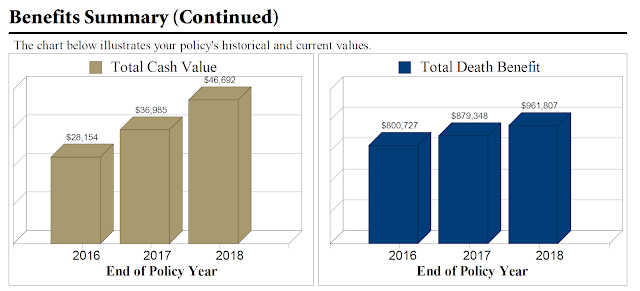
Rather than a passport savings account, I show my kids their annual statement which includes information like the picture above.  In fact, that’s from my daughter’s latest statement ending last year. 


What’s really cool is that the combined wealth my kids have already accumulated has helped them fund a stake in an apartment complex where projected investor returns will average 8.8% cash-on-cash and 19.1% annualized return on investment (ROI) over a proposed 7-year hold period.


Meanwhile, the cash values they’ve accumulated will still be growing in their policies… money working in two places at one time which I call Dual Compounding. 


Pretty cool, right?  And did you notice the death benefit is just coming along for the ride, too?  I’ve not only set up my kids for financial success when they come of age but I’ve also created a legacy that will impact multiple generations of my family tree.


What will you choose for yourself and your kids?  Click the photo above and I’ll show you how to get started in 3 simple and easy steps.


Cheers,

John Montoya
IBC® Authorized Practitioner